Luvinci
July 13, 2026
Free Printable Kindergarten Readiness Checklist (One-Page PDF)
Free printable · PDF · 437 KB
Free Printable Kindergarten Readiness Checklist (One-Page PDF)
No signup needed. Just print it.
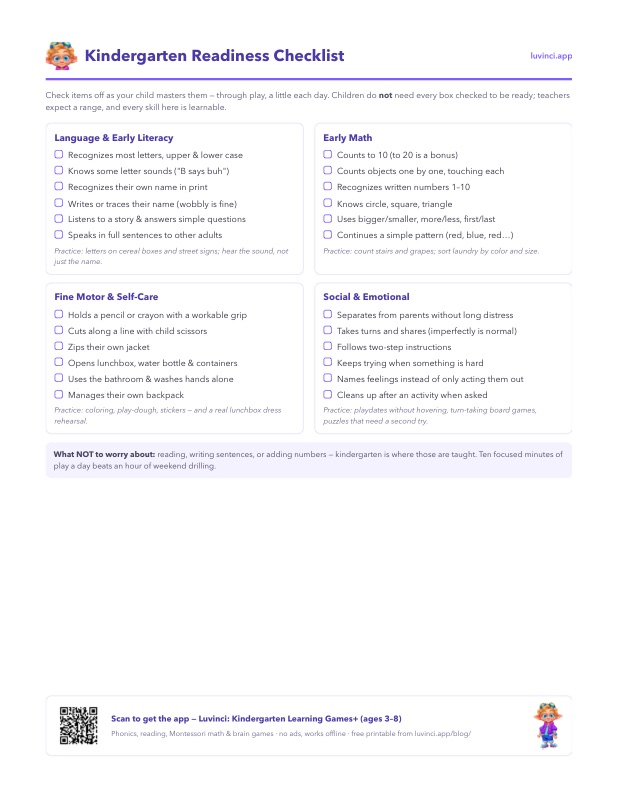
Download PDFHere is a free printable kindergarten readiness checklist you can put on the fridge today: download the one-page PDF. It covers the 24 skills kindergarten teachers actually hope to see — across early literacy, math, fine motor and self-care, and social-emotional readiness — with a practice idea for each area.
No email address required, no signup. Print it, stick it somewhere visible, and check boxes off over the summer.
What’s on the checklist
The printable condenses the four readiness domains into six checkable skills each:
- Language & early literacy — letter recognition, some letter sounds, name recognition, story listening
- Early math — counting 10 objects, numbers 1–10, shapes, patterns, comparison words
- Fine motor & self-care — pencil grip, scissors, zippers, the all-important lunchbox
- Social & emotional — separating calmly, taking turns, two-step instructions, persistence
Each section ends with a one-line practice idea, because every skill on the page is learnable through ordinary play. For the reasoning behind each item — and what teachers don’t expect — see the full kindergarten readiness checklist guide.
How to actually use it
Don’t treat it as a test. The checklist works best as a gentle radar, not a report card. Skim it once, notice the two or three boxes that feel furthest away, and fold practice into daily life — count the stairs, sound out one cereal-box letter, run a lunchbox dress rehearsal.
One domain per week works well. If school starts in a couple of months, rotating focus weekly covers everything without pressure — our summer prep plan lays out exactly that rhythm, week by week.
Let your child check the boxes. Four- and five-year-olds love ticking things off. Ownership turns preparation into a game, and the checklist becomes something they’re proud of rather than something done to them.
Revisit monthly, not daily. Skills at this age arrive in bursts. A box that’s empty in July is very often checked by August without any drilling at all.
A note on the boxes you can’t check yet
Every kindergarten classroom in September holds children who can read and children still learning letter names — teachers plan for exactly that range. If letters or counting need a boost, ten minutes a day of playful practice genuinely moves the needle: letter-sound games for the literacy boxes, hands-on counting activities for the math ones, and puzzles with a gentle difficulty curve for persistence.
And the boxes that matter most — lunchboxes, bathroom independence, taking turns — are practiced at the kitchen table and on playdates, free of charge.
The takeaways
- Download the PDF — one page, 24 skills, no signup
- Radar, not report card — aim for “most boxes,” not all
- Let your child do the checking — it turns prep into a game
- Empty boxes in July are normal — revisit monthly and let play do the work
Teachers and homeschool groups: you’re welcome to print and share the checklist freely — a link back to this page is appreciated.